
Best AI & Machine Learning Platforms in 2026 — An Honest Review The AI software market has exploded. Every few months, a new platform appears promising to be the easiest, fastest, or most powerful option available. For someone just getting started — or even a seasoned engineer evaluating options — it is genuinely hard to know where to begin.
This guide cuts through the noise. No hype, no paid rankings. Just a straightforward look at twelve popular platforms: who they actually work best for, what they do well, and what to watch out for before you commit.
1.Microsoft Azure Machine Learning
Microsoft Azure Machine Learning
If your company already runs inside the Microsoft ecosystem — Office 365, Azure DevOps, Active Directory — then Azure ML will feel like a natural extension rather than something entirely new to learn. It is a mature, enterprise-grade platform built for teams that need serious security controls, compliance certifications, and the ability to scale without worrying too much about infrastructure.
The drag-and-drop designer is genuinely useful for non-engineers who need to prototype quickly, while the MLOps pipeline support gives data science teams the structure they need to move models from experiments into production reliably.
What works well:
- Enterprise-level security and compliance built in
- Deep integration with the broader Azure cloud
- Strong deployment and monitoring tools
Where it falls short:
- Steep learning curve for first-time users
- Costs can climb quickly at scale
Best for: Large organizations, heavily regulated industries, teams already invested in Azure.
2.Amazon SageMaker
SageMaker is Amazon's answer to the full machine learning lifecycle, and it does a thorough job covering every step — from cleaning and labeling data all the way through to serving predictions in real time. If your infrastructure already runs on AWS, this is probably the most integrated option you will find.
The real strength here is scalability. SageMaker handles the kind of workloads that would overwhelm most local setups, and it does so without requiring you to manage the underlying servers yourself. The trade-off is that it takes real time to understand properly, and AWS billing has a way of surprising people.
What works well:
- End-to-end ML workflow in one place
- Tight AWS ecosystem integration
- Excellent production-scale performance
Where it falls short:
- Learning curve is genuinely steep
- Cost management needs careful, ongoing attention
Best for: AWS-first companies, production AI systems, enterprise ML teams.
3.Google Vertex AI
Vertex AI is where Google has consolidated its AI work — and given that Google is behind TensorFlow, BERT, and Gemini, there is a lot of genuine depth here. What makes it particularly relevant right now is its first-class support for generative AI. If you are building applications on top of large language models or multimodal systems, access to Gemini's APIs through Vertex is hard to match from any other cloud provider.
It handles both traditional AutoML tasks and cutting-edge generative workloads in the same platform, which reduces the need to stitch together multiple services. Beginners may find the breadth of tools a bit overwhelming at first, but for AI startups or teams focused on NLP, it is one of the strongest choices available.
What works well:
- Best-in-class generative AI and NLP tooling
- Gemini integration is a genuine differentiator
- Clean integration across Google Cloud services
Where it falls short:
- Heavy reliance on Google Cloud infrastructure
- Some advanced tools have a noticeable learning curve
Best for: Generative AI applications, NLP projects, AI-focused startups.
4. Databric
Databricks started as a platform for big data engineering and has grown into something much broader. Today it sits at the intersection of data engineering, analytics, and AI — what the company calls a "Lakehouse" architecture. If your organization is processing massive data pipelines and also wants to train and deploy ML models in the same environment, Databricks is worth serious consideration.
The collaborative notebook environment works well for teams, and Apache Spark integration means it can handle data at a scale most other platforms simply cannot. That said, it is firmly aimed at enterprise data science teams, and the pricing reflects that.
What works well:
- Outstanding big data handling at scale
- Strong team collaboration through shared notebooks
- MLflow integration makes experiment tracking clean and organized
Where it falls short:
- Setup is complex, especially for newcomers
- Enterprise pricing is a significant commitment
Best for: Data-heavy enterprises, teams blending analytics with AI, large-scale data science.
5.TensorFlow
TensorFlow has been around since 2015 and remains one of the most production-tested deep learning frameworks in existence. It was built by Google's Brain team to handle the neural network workloads that power real products — image recognition, translation, recommendations — and that production focus shows throughout the ecosystem.
TensorFlow Lite lets you shrink models down to run on mobile devices, which is useful if you are building a mobile app. The community is enormous, which means answers to most problems already exist somewhere. Beginners sometimes find the API more verbose compared to PyTorch, but for anyone building systems that need to run reliably at scale, it is hard to argue with TensorFlow's track record.
What works well:
- Massive, active community with extensive resources
- Production-ready deployment ecosystem
- Excellent mobile and edge support via TensorFlow Lite
Where it falls short:
- Syntax can feel verbose and heavy for beginners
- Debugging complex models can get tricky
Best for: Production ML systems, deep learning projects, mobile AI deployment.
6. PyTorch
Ask most AI researchers which framework they prefer, and the answer these days is almost always PyTorch. Developed by Meta's AI lab, it uses a dynamic computation graph that makes experimenting and debugging feel much more natural. The fact that it behaves like regular Python code makes it far less intimidating to pick up.
The research community's adoption of PyTorch has been staggering — the vast majority of papers published at top AI conferences use it, which means cutting-edge architectures typically appear as PyTorch implementations first. The one trade-off is that deploying to production has historically been slightly more involved than TensorFlow, though that gap has narrowed considerably in recent years.
What works well:
- Intuitive, Pythonic API that feels natural to use
- Dominant in AI research — huge model ecosystem
- Flexible and easy to debug
Where it falls short:
- Production deployment is slightly more involved than TensorFlow
- Less enterprise tooling compared to the major cloud platforms
Best for: AI researchers, deep learning developers, computer vision projects.
7. Scikit-learn
If you are new to machine learning and working in Python, Scikit-learn is almost certainly where you should start. It is the gold standard for classical machine learning — everything from logistic regression and decision trees to clustering and dimensionality reduction. The API is remarkably consistent, the documentation is some of the best in open source, and it integrates cleanly with NumPy and Pandas.
It is worth being honest about what Scikit-learn is not: it is not a deep learning framework, and it is not built for GPU-heavy workloads. But for classification, regression, and data preprocessing tasks, it remains indispensable — even for experienced practitioners who use PyTorch or TensorFlow for the heavy lifting.
What works well:
- Genuinely beginner-friendly with a consistent API
- Excellent, well-maintained documentation
- Lightweight and fast to iterate with
Where it falls short:
- No deep learning capabilities
- Not designed for large-scale GPU workloads
Best for: ML beginners, data analysis, classical machine learning tasks.
8. MATLAB
MATLAB occupies a specific and well-defended niche: engineering and scientific computing. If you work in signal processing, control systems, robotics, or any field where numerical simulation matters, MATLAB's toolboxes are genuinely hard to replace. Its AI and deep learning capabilities have improved considerably in recent years, and it integrates naturally into workflows involving hardware and simulation.
The honest caveat is that MATLAB's licensing costs are significant, and the open-source world — Python in particular — has largely caught up for most tasks. It remains the right tool in academic and engineering contexts where those specialized toolboxes are genuinely needed, but it is harder to justify for general-purpose ML work.
What works well:
- Unmatched for engineering simulation and numerical computing
- Strong data visualization tools
- Deep roots in academic and research institutions
Where it falls short:
- Expensive licensing fees
- Python has overtaken it for most mainstream ML tasks
Best for: Engineers, academic researchers, scientific computing applications.
9. H2O.ai
H2O.ai has built a strong position in the AutoML space — the idea that the platform can automatically select, tune, and compare models on your behalf without requiring deep ML expertise. For business analysts and domain experts who want to build predictive models without becoming data scientists, it is a genuinely capable option. The enterprise offering adds governance and explainability features that regulated industries often require.
What works well:
- Strong AutoML with very little setup required
- Enterprise-ready with model governance features
- Good for teams without dedicated ML engineers
Where it falls short:
- Limited flexibility for advanced customization
- Some enterprise features carry additional cost
Best for: Business analysts, teams needing AutoML, regulated industries.
10. KNIME
KNIME takes a visual, workflow-based approach to data science. You build pipelines by connecting nodes on a canvas — each node represents a step like reading data, cleaning it, running a model, or exporting results. For people who think visually or need to document their analytical process clearly, this approach has real advantages. No coding is required to get started.
What works well:
- No coding required — everything is visual
- Strong data integration from many source types
- Easy to document and share workflows with teammates
Where it falls short:
- Complex workflows can slow down noticeably
- The interface feels somewhat dated compared to newer tools
Best for: Non-programmers, data analysts, data integration workflows.
11. RapidMiner
RapidMiner sits in a similar space to KNIME but leans more toward business analytics use cases. The drag-and-drop interface makes it easy to automate analytical workflows, and it is well suited to teams that need to run regular reports or build predictive models without heavy engineering involvement. Advanced users sometimes bump into its limitations, but for the business analytics audience it targets, it does the job well.
What works well:
- Good automation for business analytics workflows
- Accessible to non-technical teams
- Solid drag-and-drop model building
Where it falls short:
- Experienced developers may find it too constrained
- Less flexibility for custom or complex ML pipelines
Best for: Business teams, automated reporting, analytics workflows.
12. BigML
BigML is the most approachable entry point on this list. It is deliberately simple: upload your data, pick a task, and the platform walks you through building a model with minimal friction. For small businesses experimenting with ML for the first time, or for students learning the basics, the setup time is almost nothing. It does not pretend to be an enterprise platform, and that honesty is actually a strength.
What works well:
- Fastest to get started of any platform here
- Clean, simple interface with no steep learning curve
- Good for quick prototyping and learning
Where it falls short:
- Limited advanced features
- Not built for enterprise scale or complex workloads
Best for: First-time ML users, small businesses, educational use.
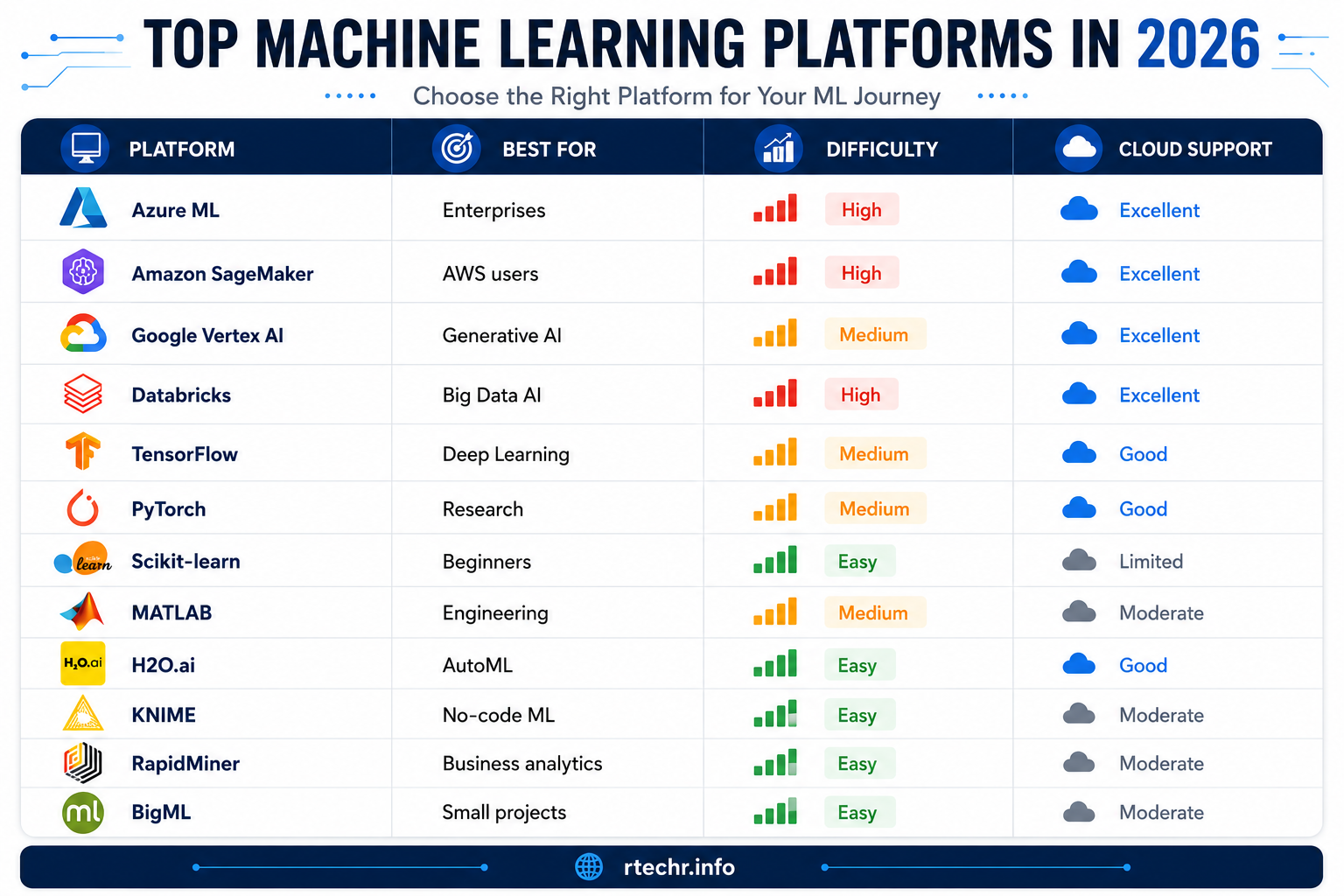
Quick Comparison
| Platform | Best For | Difficulty | Cloud Support |
|---|---|---|---|
| Azure ML | Enterprises | High | Excellent |
| Amazon SageMaker | AWS users | High | Excellent |
| Google Vertex AI | Generative AI | Medium | Excellent |
| Databricks | Big Data AI | High | Excellent |
| TensorFlow | Deep Learning | Medium | Good |
| PyTorch | Research | Medium | Good |
| Scikit-learn | Beginners | Easy | Limited |
| MATLAB | Engineering | Medium | Moderate |
| H2O.ai | AutoML | Easy | Good |
| KNIME | No-code ML | Easy | Moderate |
| RapidMiner | Business analytics | Easy | Moderate |
| BigML | Small projects | Easy | Moderate |
Final Thoughts
The biggest mistake people make is reaching for the most powerful tool before they are ready for it. A platform like SageMaker or Azure ML is extraordinary when used by a team that knows what it is doing. In the hands of someone just starting out, it mostly produces confusion and unexpected bills.
Just getting started? Go with Scikit-learn, KNIME, or BigML. They will teach you the fundamentals without getting in your way.
Building production or enterprise systems? Microsoft Azure ML, Amazon SageMaker, and Google Vertex AI are the industry standards — pick the one that matches your existing cloud infrastructure.
Doing deep learning or AI research? PyTorch and TensorFlow are what the field runs on. Start with PyTorch if you are doing research; lean toward TensorFlow if production deployment is the priority.
Start with what matches your current skill level, not where you hope to be in two years. The best tool is the one that helps you actually ship something.